
Printable guide· NSW
Union Delegate Guide: When a Member Is Hurt at Work
Two pages for delegates: the first conversation, the certificate, who pays, and when to escalate.
Download the Guide (A4, 2 Pages)
- Download
A4 guide (office printer)
PDF
2 pages · 69 KB
v2 — October 2026 · Updated
Rather have it printed for you? Order copiesWhat the Delegate Guide Covers
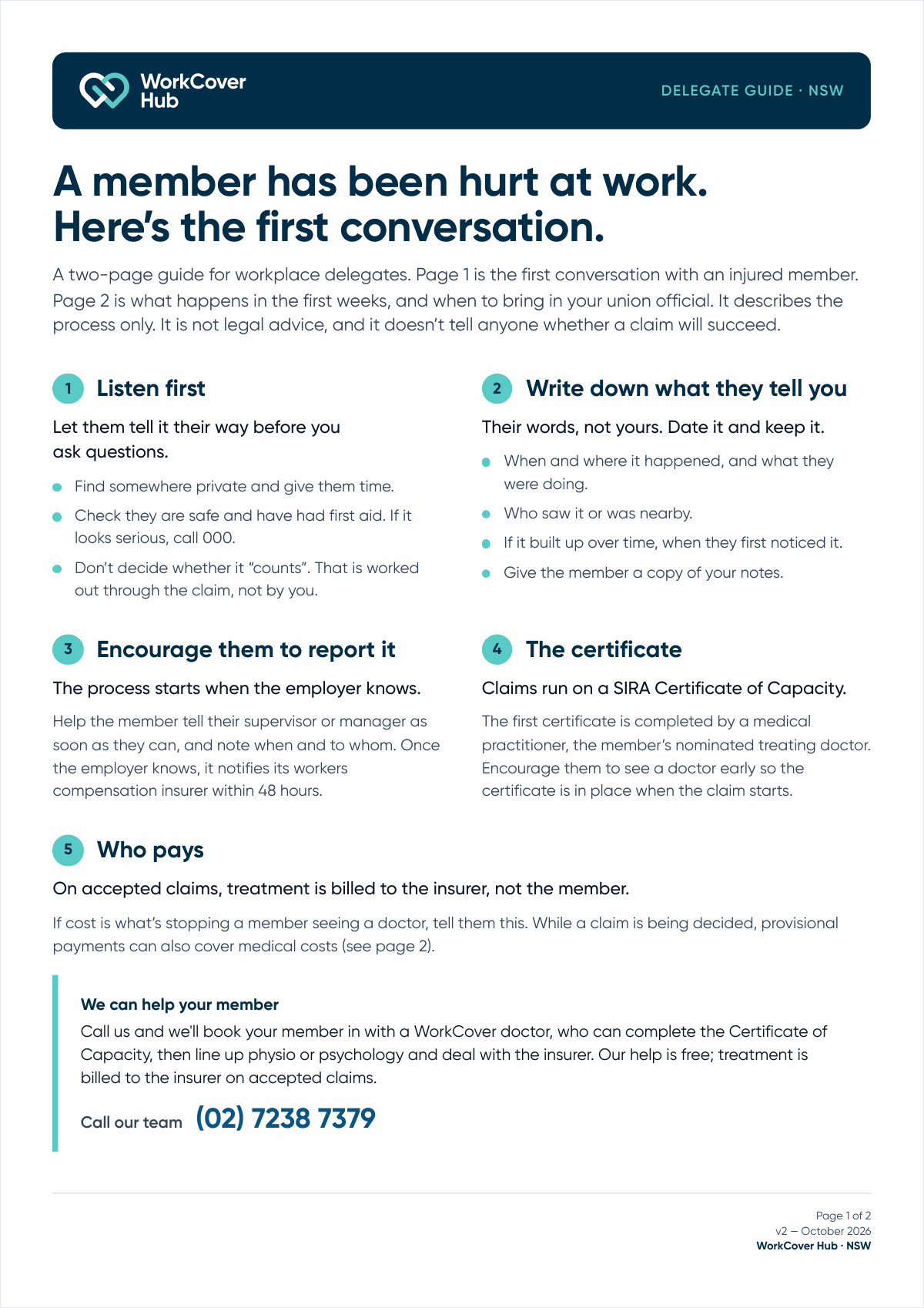
A member has been hurt at work. Here’s the first conversation.
Page 1 is the first conversation with an injured member. Page 2 is what happens in the first weeks, and when to bring in your union official. It describes the process only. It is not legal advice, and it doesn’t tell anyone whether a claim will succeed.
1. Listen first
Let them tell it their way before you ask questions.
- Find somewhere private and give them time.
- Check they are safe and have had first aid. If it looks serious, call 000.
- Don’t decide whether it “counts”. That is worked out through the claim, not by you.
2. Write down what they tell you
Their words, not yours. Date it and keep it.
- When and where it happened, and what they were doing.
- Who saw it or was nearby.
- If it built up over time, when they first noticed it.
- Give the member a copy of your notes.
3. Encourage them to report it
The process starts when the employer knows.
- Help the member tell their supervisor or manager as soon as they can, and note when and to whom. Once the employer knows, it notifies its workers compensation insurer within 48 hours.
4. The certificate
Claims run on a SIRA Certificate of Capacity.
- The first certificate is completed by a medical practitioner, the member’s nominated treating doctor. Encourage them to see a doctor early so the certificate is in place when the claim starts.
5. Who pays
On accepted claims, treatment is billed to the insurer, not the member.
- If cost is what’s stopping a member seeing a doctor, tell them this. While a claim is being decided, provisional payments can also cover medical costs.
What happens in the first weeks
The usual order of events in NSW. Your job is to know the shape of it, not to run it.
- 48 hours: The employer notifies its insurerOnce the employer knows about the injury, it tells its insurer within 48 hours.
- 7 days: Provisional payments can startThe insurer starts provisional weekly payments within 7 days unless it has a reasonable excuse. They can run for up to 12 weeks, and provisional medical costs can be covered up to $10,000.
- 6 months: The time limit to make a claimA claim is to be made within 6 months of the injury, with limited relief up to 3 years.
- After a decision: Internal review existsIf the insurer declines or reduces a claim, the member can ask for an internal review by the insurer. Most disputes beyond that go to the Personal Injury Commission; from 1 July 2026 some psychological injury disputes go to the Industrial Relations Commission. The Independent Review Office handles complaints about insurers.
When to bring in your union official
Hand over early. These are signs the member needs more than a delegate.
- The insurer declines, reduces or stops payments.
- No provisional payment has arrived after 7 days and nobody has said why.
- The member is near the 6-month mark and no claim has been made.
- The injury is psychological. The NSW rules for psychological injury changed from 1 July 2026.
- Suitable duties don’t match the certificate, or the member says their job is under threat.
- The member is asked to sign something, give a statement or attend an interview and is unsure.
- Anything that sounds like a legal question. You aren’t expected to answer it.
Need the member seen by a doctor?
(02) 7238 7379Call us and we'll book your member in with a WorkCover doctor, who can complete the Certificate of Capacity where clinically appropriate. Billed to the insurer on accepted claims.
Sources printed on it
The First Conversation With an Injured Member
The delegate is often the first person an injured member talks to. This guide walks through that first conversation, how the Certificate of Capacity works, who pays for treatment, and when to escalate within the union. It describes the process; it does not give legal advice.
Who It Is For
Union delegates, organisers and branch officials.
- Unions
Certificates, Who Pays and When to Escalate
- The first conversation: what to ask and what to write down
- The Certificate of Capacity and who completes it
- Who pays for treatment, and when to escalate within the union
Questions About the Guide
Order Printed Copies
Tell us how many, and where to send them. Add other items from the toolkit to the same order if they suit your people.
Prefer to talk it through? Call (02) 7238 7379
More for Unions and Delegates
poster
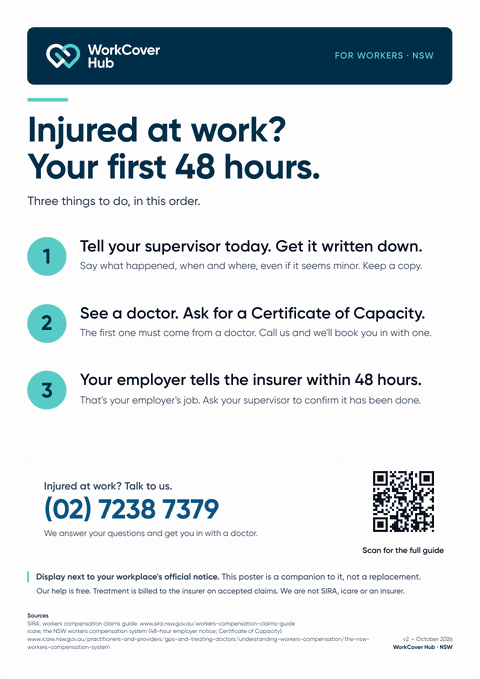
Injured at work? Your first 48 hours.
The three things to do on day one, for the lunchroom wall.
3 formats · PDFView and download
wallet card
Injured at work? Three steps for your wallet.
Credit-card sized: three steps and a phone number, kept where the worker will have them.
2 formats · PDFView and download
poster
Crash on the way to or at work?
WorkCover, CTP or both: the first steps after a crash that involves work.
3 formats · PDFView and download